Concept Testing 101: A Framework for Go/No-Go Decisions
When you have an idea for a new product (or service), there is one basic question. Will people want it?
Concept testing helps answer that question before you spend time and money building the product.
What a Concept Test Measures
A concept test measures interest in an idea before the product exists.
You are not testing the product itself. You are testing the idea as it is explained to people.
This matters. A good idea can test poorly if the description is confusing. A weaker idea can test well if the description is clear and appealing. The results only reflect what people see and read.
Because of this, the concept description requires thorough consideration and needs to be clear and realistic.
The Core Metrics
Most concept tests measure some combination of these:
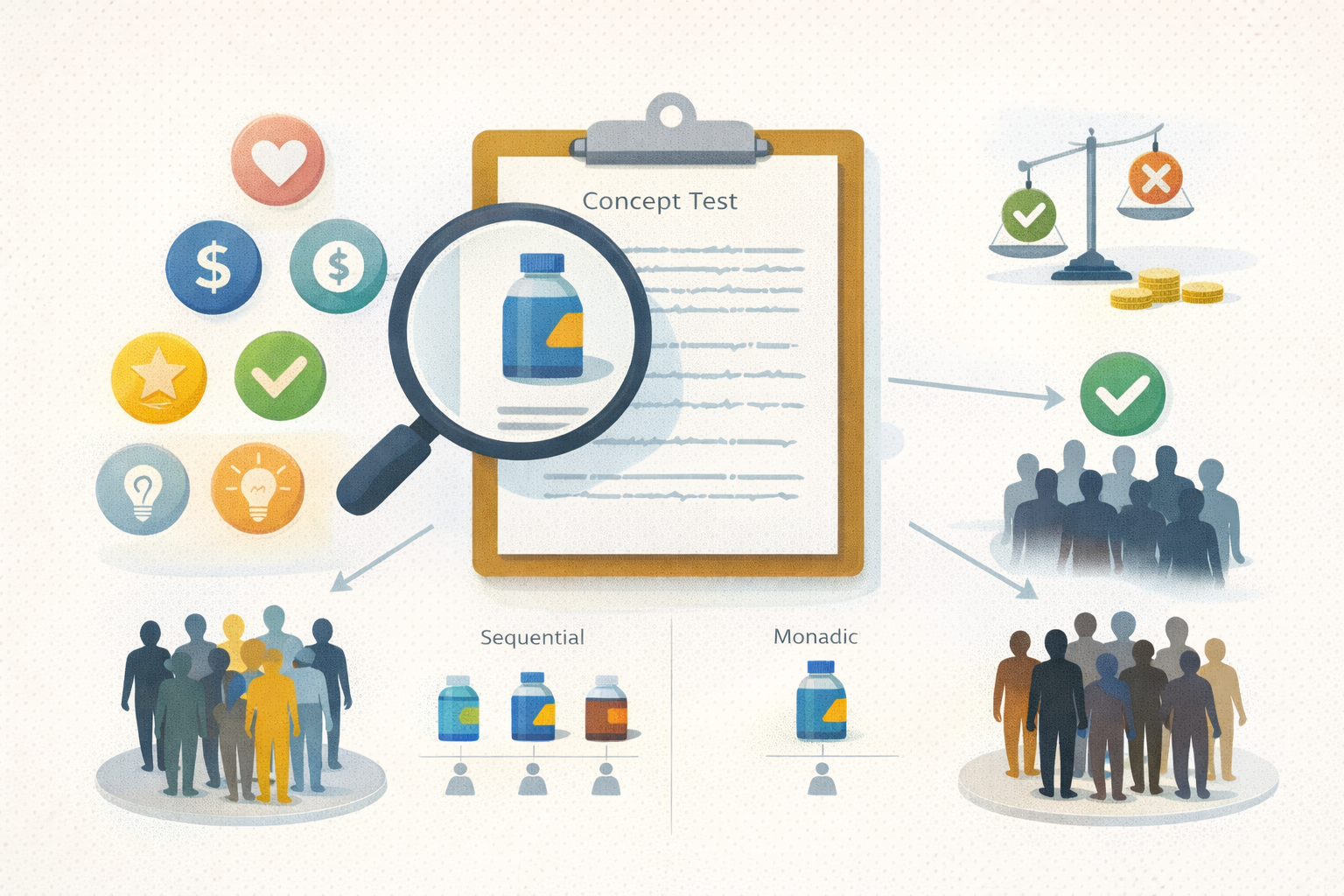
Appeal: This measures their immediate emotional reaction to the idea independent of price or need.
Purchase Intent: This asks how likely someone would be to buy the product. Intent data is useful, but people often say they would buy things that they never actually buy. This data should be used directionally.
Uniqueness: This measures whether the product feels different from what is already available. If it does not stand out, it may struggle.
Relevance: This asks whether the product solves a problem the person actually has. Concepts that are interesting but not useful tend to perform poorly.
Believability: This measures whether people trust the claims being made. Promises that sound unrealistic often hurt performance.
Value: This looks at whether the product feels worth the price. This is often tested using more than one price.
Monadic vs. Sequential
There are two common ways to run a concept test.
Monadic: Each respondent sees only one concept. This keeps results clean and avoids comparison effects. It also requires more total respondents.
Sequential: Each respondent sees multiple concepts. This uses sample more efficiently but requires careful design to avoid order effects.
Sequential designs are often used early, when testing many ideas. Monadic designs are more common for final go or no-go decisions. (For a deeper dive, see our Best Practices for Concept Testing.)
Setting Goals Before Testing
Before running the study, it helps to decide what success looks like.
What purchase intent score is good enough to move forward? What level of uniqueness is acceptable? Setting these rules ahead of time makes the ultimate decisions easier.
If you do not have benchmarks, testing against a comparison can help. This might be a current product or a competitor idea. Comparing results is often easier than judging scores on their own.
What Concept Testing Can't Tell You
Concept testing has limits:
It does not tell you how well the final product will be made. A strong idea can fail if the product does not deliver.
It does not guarantee people will notice your marketing.
It does not account for distribution, availability, or how competitors may react.
Concept testing lowers risk, but it does not remove it.
Making the Decision
The goal of concept testing is to support decisions, not make them for you.
Strong results should increase confidence. Weak results should raise concerns. Mixed results require judgment about what can be fixed and what cannot.
One common mistake is launching a concept that tested poorly and hoping the final product will do better. That rarely works.
Concept testing is most useful when its results are taken seriously and used to guide clear go or no-go decisions.