How Many Respondents Do You Actually Need?
“How many respondents do we need?” is one of the most common questions in market research.
The honest answer is that it depends. That answer is not very useful on its own, so it helps to be clear about what it depends on.
The Factors That Matter
Sample size decisions are affected by a few basic factors:
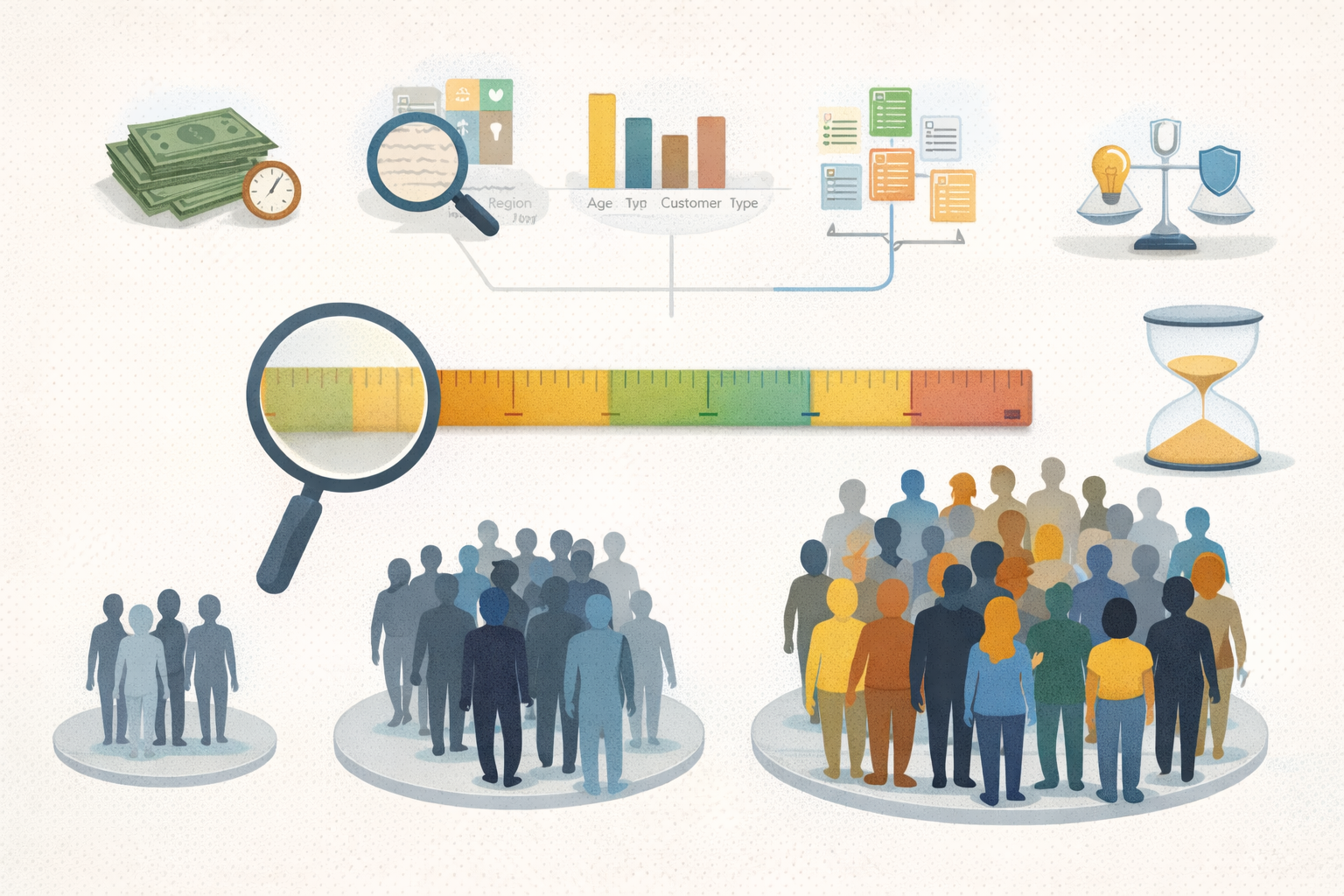
How precise do you need to be? If you’re looking for large differences, you can work with fewer respondents. If you need to detect small differences, you need more.
How many subgroups do you need to analyze? If you plan to look at results by region, age, or customer type, each of those groups needs enough respondents on its own, so the overall sample must be bigger.
How complex is your research? More direct studies, like ad or concept tests, need smaller samples than segmentation or conjoint studies.
What’s the purpose of the research? Higher risk decisions typically justify larger samples, as does research conducted for PR and press outreach where credibility is critical.
What’s your budget, and when do you need results? Bigger sample sizes come with higher costs and longer timelines, so you need to consider budget and time constraints.
Practical Guidelines by Study Type
While every project is different, here are reasonable starting points:
Concept Tests: n=150-300 (minimum) per concept. If you're testing multiple concepts monadically (each respondent sees one concept), you need this per cell. Sequential testing can reduce the total sample needed.
Ad Testing: n=100-200 (minimum) per ad. Often you can use a sequential design where each respondent evaluates 2-3 ads, reducing the total sample.
Brand Tracking: n=500 per wave at minimum for stable tracking metrics. More if you need robust subgroup analysis.
Segmentation: n=500-1,000+ minimum. Cluster analysis and factor analysis require larger samples for stable solutions. We typically recommend 800-1,000. (See our segmentation guide for more detail.)
Conjoint/MaxDiff: n=200-400 for aggregate results; n=150+ per segment if you need results by segments (Our conjoint checklist covers this in more detail.)
The Subgroup Issue
This is where sample planning often goes wrong. You start with n=400, which seems reasonable. Then someone asks to see results by region (4 groups = n=100 each). Then by age group (another 3-4 cuts). Suddenly you're looking at cells of n=25-30, which is too small to draw meaningful conclusions.
Before fielding, identify every subgroup you'll need to analyze and ensure each one has sufficient base size. A good rule of thumb: n=100+ for stable percentages, n=30+ as an absolute minimum for directional findings.
When Bigger Isn't Better
More sample isn't always the answer. If you’re doing gut-check style research, a simple A/B test or just need results in total, smaller sample sizes will work. Operationally, you may be limited in sample size by budget or time constraints.
The Budget Reality
Sample has a cost. When budgets are limited, tradeoffs are often required.
This might mean testing fewer concepts, analyzing fewer subgroups, or using simpler methods. That is usually better than trying to do everything with too little sample.
Collecting too small a sample and realizing the results are not usable is unfortunately a common mistake. It is much better to adjust the scope of the study early, rather than try to fix problems after the data is collected.
(If the budget is tight, for certain types of research, you can consider using your email list for research as a cost-effective starting point)